Jump to Main Jump zu Navigation Jump to Contact

    Microelectronics Research at Leibniz University Hannover

    Leibniz University Hannover conducts microelectronics research at several institutes. The Institute for Microelectronic Systems (IMS) focuses on the conception, design, and evaluation of integrated mixed-signal and power-management circuits, as well as digital architectures, algorithms, and circuits.

    The Institute for Materials and Electronic Components (MBE) focuses on novel developments for nanoelectronics, particularly crystalline materials and epitaxial heterostructures, and conducts research on the use of semiconductor technologies for highly efficient solar cells.

    The Institute for Microproduction Technology (IMPT) develops microelectromechanical systems (MEMS) for applications in quantum technology, sensor technology, and biomedical engineering, with core competencies in thin-film technology, patterning technology, and interconnection technology.

    Infrastructure

    Environment

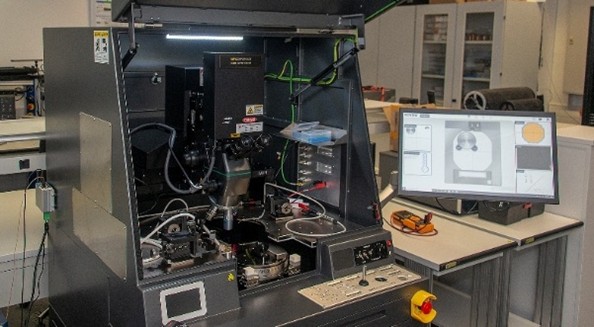
    • Fully equipped laboratories with circuit simulation software (Cadence, Synopsys, etc.), tools for PCB and IC assembly, and state-of-the-art measurement equipment, including high-bandwidth oscilloscopes, network analyzers, high-end thermal imaging cameras, high-voltage SMUs/test stations with laser cutters, and thermal clamping fixtures.
    • Several ISO Class 5 cleanrooms equipped for photolithography, chemical, physical, and electrochemical deposition, wet and dry etching, as well as surface and electrical analysis.

    Institute for Microelectronic Systems, Mixed-Signal Circuits Division

    • Design of integrated mixed-signal circuits for automotive electronics, medical technology, power electronics, and high-temperature electronics
    • Power management and sensor front-end ICs
    • Monolithic GaN integration (GaN-ICs)

    Institute for Microelectronic Systems, Department of Architectures and Systems

    • Architectures and Integrated Circuits for Biomedical Engineering and Signal Processing in Autonomous Driving
    • Digital Signal Processing Architectures (DSP, FPGA, Multi-/Manycore, GPU, MPSoC, etc.)
    • Electronics under harsh environmental conditions

    Institute for Materials and Electronic Components

    • Si- and perovskite-based nanoelectronics (fabrication, structural and electrical characterization)
    • crystalline materials and material combinations (epitaxial heterostructures)
    • high-efficiency Si and perovskite solar cells

    Institute for Microproduction Technology

    • Micro-Electromechanical Systems (MEMS)
    • Thin-Film Technology
    • Structuring Technology
    • Assembly and Joining Technology
    • Mechanical Processing and Characterization of MEMS and NEMS Materials

    Relevant Clusters of Excellence: PhoenixD, H4A, Quantum Frontiers

    CAPA – Collaboration for Advanced Packaging and Assembly (LUH)

    NTC BRIGHT (TUBS & LUH)

    ForMikro Projects: ERMI

    Teaching